
You’ve tried the open houses. You’ve printed the flyers. You’ve even boosted a few Facebook posts.
But your enrollment numbers? Still flat.
You’re not alone. Schools across the country are facing what experts call the “enrollment cliff”—a perfect storm of declining birth rates, increased competition from charter and online schools, and parents who are more selective than ever about where they send their children .
The good news? Schools that adapt are not just surviving—they’re thriving.
After working with over 500 private and independent schools, I’ve seen exactly what separates schools that fill their seats from those that struggle. The strategies below aren’t theory. They’re proven tactics that are working right now in 2026
Why Traditional Enrollment Tactics Are Failing
Let’s be honest. Most school marketing still looks like it did in 2010.
Static websites that act like digital brochures. Generic “We’re great!” messaging. Sporadic social media posts that get buried in the algorithm before parents even see them .
Meanwhile, parents have changed how they search for schools.
68% of parents visit a school’s website multiple times before ever reaching out —but most school sites still aren’t designed to capture those leads .
Parents aren’t just looking for information anymore. They’re looking for *connection*. They want to see themselves and their child in your school’s story. And if they can’t find that within the first 30 seconds on your website? They’re gone.
The schools winning in 2025 understand this shift. They’ve moved from transactional recruitment to strategic relationship-building .
Here’s how you can do the same.
1. Turn Your Website Into a Lead Generation Engine (Not a Brochure)
Your website isn’t just a digital business card. It’s your hardest-working admissions counselor—available 24/7.
But here’s the problem: most school websites ask parents to do all the work. They have to hunt for information, dig through PDFs, and figure out how to contact you.
The fix: Embed lead capture tools directly into your site.
Think interactive quizzes (“Is our school right for your child?”), instant tuition estimators, or simple “Request Info” forms that don’t require creating an account .Using this method, one school generated 32 qualified leads per week from its credit evaluation tool.
1️⃣ What “Interactive Quiz” Means
Instead of just showing boring website pages, the website asks the visitor questions.
Example for a school website:
Quiz Title
“Is Our School the Right Choice for Your Child?”
Parent clicks Start Quiz.
Then questions appear:
- What class are you looking for?
- Nursery
- Primary
- Secondary
- Nursery
- What is your priority?
- Academics
- Sports
- Activities
- Academics
- Do you prefer:
- CBSE
- ICSE
- State board
- CBSE
At the end the website shows:
“Based on your answers, our school could be a great fit for your child.”
Then ask:
Enter phone/email to get admission information.
Now the school gets a lead.
2️⃣ What “Instant Tuition Estimator” Means
Parents always want to know fees but schools often hide it.
Instead of forcing parents to call, the website shows a fee calculator.
Example:
Fee Estimator
Parent selects:
Class → Grade 1
Transport → Yes
Activities → Yes
Website instantly shows:
Estimated yearly fee: ₹55,000 – ₹65,000
Then show:
“Want detailed fee structure? Enter your phone number.”
Now the school gets a serious admission enquiry.
3️⃣ What “Request Info Form” Means
Many websites make people:
- Create account
- Login
- Verify email
Parents don’t like that.
Instead use a simple form:
Name
Phone
Child Class
Button:
Request Admission Information
Takes 5 seconds.
More parents will fill it.
7️⃣ How WEBOUL Can do it
“Instead of just a normal website, we build interactive school websites that capture admission enquiries automatically.”
Features we include:
• Admission Quiz
• Fee Calculator
• Instant Enquiry Form
• WhatsApp Enquiry Button
But this is only the basic level.
We have developed a complete “School Admission Lead Machine Website Structure” designed specifically to help schools generate more admission
👉 If you want to see how this Admission Lead Machine works for schools, you can get the full structure.
| Form |
| 1️⃣ Full Name 2️⃣ School Name 3️⃣ City / Location 4️⃣ Phone Number / WhatsApp 5️⃣ Email Address |
Our team will send you the full strategy and show how schools can turn their website into an admission-generating system.
Action step: Add one interactive element to your homepage this week. something that collect parents’ contact information and provides them with instant value.Comment us what it goona be
Here’s a sobering statistic:
If you wait more than 48 hours to respond to an inquiry, your chances of converting that family drop by 30%.
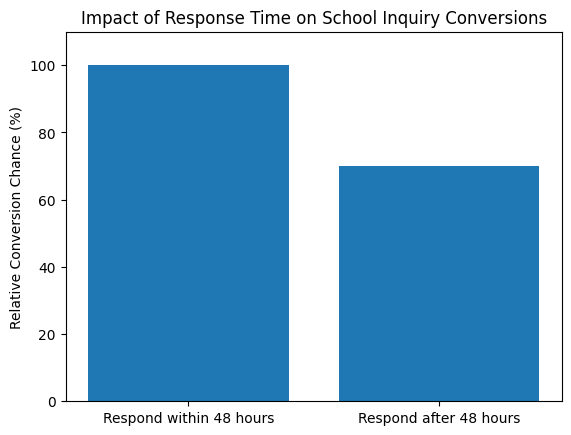
Not 2 weeks. Not 2 days. Forty-eight hours.
Parents are shopping around. While you’re crafting the perfect response email, three other schools have already called them back.
But speed without personalisation is just spam
The solution?
👉 When parents ask about admission, schools should not send the same message to everyone.
Instead, they should send messages based on what the parent asked.
This is called Smart Automation.
Example Situation
A parent fills this form on a school website.
Question: (from website)
What information do you want?
Options:
• Admission process
• Fee structure
• Financial aid / scholarship
• School facilities
Now imagine the parent selects:
Financial Aid
Bad Follow-Up (What Most Schools Do)
School sends this email:
“Thank you for contacting us. Our school has excellent sports facilities and a big playground.”
Parent thinks:
❌ I asked about fees, not sports.
Result:
Parent loses interest.
Smart Follow-Up (What Automation Does)
If parent asked about financial aid, the system automatically sends:
Email:
“Thank you for your interest in our school. Many parents ask about affordability. Our school offers scholarship programs and flexible fee options. You can learn more here.”
Now the parent feels:
✔ The school understood their concern.
This increases chance of admission.
Action step: Set up an automated email sequence that goes out within 2 hours of inquiry. Include a personal video message from your admissions director. It takes 30 seconds to record and creates an instant human connection.
How WEBOUL can help you
“Most schools lose admission enquiries because they respond late or send generic replies. We build automated enquiry systems that respond to parents within minutes and send personalized information.”
Now you are not selling a website.
You are selling an admission system.
3. Segment Your Messaging (One Size Fits No One)
We noticed that Parents who want admission for a small child (kindergarten) worry about different things than parents who want admission for an older student (high school).
Their questions, priorities, and fears are different
Create specific “personas” for your different family types :
Parents of a Kindergarten Child
These parents usually worry about:
• Safety
• Caring teachers
• Friendly environment
• Play-based learning
• Clean classrooms
• School distance from home
Typical questions:
- Is my child safe here?
- Are teachers kind?
- Is learning fun?
- Are there playgrounds?
They care about comfort and care.
Parents of a High School Student
These parents worry about completely different things:
• Board exam results
• Science / commerce streams
• Career preparation
• Competitive exam coaching
• College placements
Typical questions:
- What is the board result percentage?
- Do you prepare students for IIT/NEET?
- What subjects are available?
They care about future success.
“Yet most schools send the same generic newsletter to everyone.”
This means schools send one message to all parents, like:
“Welcome to our school. We have great facilities and activities.”
Stop doing that
When Peddie School implemented segmented inquiry forms, they could immediately route families to the right follow-up content. Families interested in basketball were introduced to coaches. Families concerned about tuition received financial aid guides.
4. Take Advantage of Parent Ambassadors
Here’s a truth bomb: Parents trust other parents more than they trust you.
According to research, 77% of consumers trust referrals from people they know . Your current families are your most underutilised marketing asset.
Our idea is about using happy parents to promote the school.
Many parents already love their child’s school and naturally talk about it with other parents.
Example places where parents talk:
- Soccer practice ⚽
- Birthday parties 🎂
- Family gatherings
- Book clubs 📚
- WhatsApp groups
These parents are called “Parent Ambassadors.”
What a Parent Ambassador Is
A Parent Ambassador is a parent whose child studies in the school and who:
✔ Loves the school
✔ Recommends it to others
✔ Shares positive experiences
Instead of waiting for random recommendations, the school officially encourages these parents to help promote the school.
What Schools Can Do
Schools should create a formal program.
Give them tools to share your story: branded business cards, social media graphics, or even simple talking points about what makes your school special .
One school I worked with saw a 23% increase in inquiries just by empowering five parent ambassadors to host casual coffee meetups for prospective families.
A parent invites other parents like this:
“I’m having coffee this Saturday with a few parents who are exploring schools for their kids. If you want, you can join.”
Location could be:
• A café
• Someone’s home
• School lounge
Very informal.
Action step: Identify your 10 most enthusiastic current parents. Send them a personal note asking if they’d be willing to chat with prospective families. Make it exclusive—”We’re selecting just a few families to be part of our ambassador circle
How we can help you
“Your happiest parents are your best marketers. We can create digital tools and referral systems so parents can easily recommend your school.”
We could provide you
• Referral landing pages
• Shareable admission posts
• Parent testimonial videos
• Referral tracking system
Want to see how it works?
👉 Contact us today to get the “School Parent Referral System Blueprint.”
5. Optimize for “Near Me” Searches (Local SEO Is Non-Negotiable)
When parents search for schools, they don’t type “best private school in America.”
They type: “best private school near me” or “Catholic school in [neighborhood name]” .
If you’re not showing up in those local searches, you might as well be invisible.
Start with your Google Business Profile. Is it fully optimised with photos, updated hours, and recent reviews? Are you using location-specific keywords throughout your website content?
But don’t stop there. Create content that mentions your specific neighborhood, nearby landmarks, and local community events. Write a blog post about “Why Families in [Your City] Choose [Your School Name].”
Action step Claim and optimize your Google Business Profile this week. Add 10 new photos of campus life. Ask five current families to leave reviews.
How our team can help you
✔ Google Business Profile optimization
✔ Local SEO for school websites
✔ Review generation strategy
✔ Location-based website content
👉 Get a Free School Local Visibility Audit.
Share your school details and our team will show you how easily parents can find your school online.
6. Showcase Real Outcomes (Not Just Features)
Parents aren’t buying a school experience. They’re buying a future for their child.
Stop leading with “small class sizes” and “dedicated faculty.” Every school says that.
Instead, show them the end result.
Randolph-Macon Academy prominently advertises that 100% of their graduates earn college acceptances, with over $15 million in scholarships for the Class of 2026 . That’s specific. That’s compelling. That’s what parents remember.
Gather your data. What percentage of your graduates get into their first-choice college? What’s your average scholarship amount? How many alumni are in leadership positions in your community?
Then tell those stories. Feature alumni who’ve become doctors, entrepreneurs, artists. Let prospective parents see their child’s potential future .
Action step: Interview three recent graduates. Create short video testimonials about where they are now and how your school helped them get there.
7. Make Financial Aid Transparent (Remove the Stigma)
Here’s a hard truth: Many families who could afford your school with aid do not apply because they are embarrassed to ask.
Or worse, they assume private school is out of reach and never even visit your website.
Schools that are winning in 2026 are proactively communicating about flexible tuition models.
- Schools should use terms like “indexed tuition” or “sliding scale” instead of “financial aid” .
Instead of saying “financial aid”, they use friendlier terms.
Why?
Because financial aid sounds like charity.
Parents might feel embarrassed.
Better words:
• Indexed tuition → Fee based on income level
• Sliding scale → Fees adjusted according to family capacity
These words feel more respectful and professional.
They host webinars explaining the process. They feature current families who received assistance (with permission) to normalize the conversation.
2. Why Schools Host Webinars
Many parents don’t understand how fee assistance works.
So schools host online information sessions.
Example webinar topic:
“Understanding Tuition Options at Our School”
In the webinar they explain:
• Fee structure
• Payment plans
• Scholarships
• Tuition adjustments
Parents feel comfortable asking questions.
One school saw a 40% increase in applications after adding a simple tuition calculator to their website that showed families their personalized rate upfront .
What the Tuition Calculator Does
The website shows a simple fee estimator tool.
Parents enter details like:
• Household income range
• Child grade level
Then the calculator shows an estimated fee.
Example:
Full tuition: ₹80,000
Calculator result:
Your estimated tuition: ₹45,000 – ₹55,000
Now parents think:
✔ “This school might be affordable for us.”
Action step: Add a “Tuition & Affordability” page to your website. Include a calculator or estimator. Use parent testimonials about how the investment was worth it.
8. Prioritize Transfer Students (The Hidden Goldmine)
Basically our idea is
Most schools try to get new kindergarten students every year. Right?
But smart schools also target transfer students.
Transfer students = students who move from another school to a new school.
Most schools compete for the same small group of parents looking for kindergarten admission.
What Smart Schools Do Instead
They also focus on students who want to change schools.
Example reasons parents transfer their child:
• Not happy with current school
• Poor teaching quality
• Bullying problems
• Child moving to another city
• School results not good
These families are already looking for a new school.
So they are easier to convert into admissions.
Why Transfer Students Are “High-Yield”
High-yield means higher chance of admission.
Why?
Because these families:
✔ Already decided to leave their current school
✔ Already know what they want
✔ Need a new school quickly
So they are very serious applicants.
Create Clear Pathways for Mid-Year Transfers
Sometimes parents want to move their child during the school year.
Example:
School year started in April
Parent wants to transfer in September
Many schools make this process confusing.
Smart schools create simple instructions like:
- Can you transfer mid-year?
- What documents are needed?
- How are grades transferred?
This makes parents feel comfortable applying.
Offer instant credit evaluations
Parents worry:
“If my child changes school, will their previous subjects and marks be accepted?”
Example:
Student studied Math, Science, English in previous school.
New school must check if those credits/subjects match their curriculum.
A credit evaluation tool helps parents know this quickly.
Example website tool:
Parent enters:
• current class
• subjects studied
• board (CBSE, ICSE, etc.)
Website replies:
✔ Subjects accepted
✔ Additional subjects required
This reduces uncertainty.
Oklahoma Christian University implemented a transfer credit calculator and saw 51 inquiries and 8 deposits within 8 months —proving that transparency drives conversions .
**Action step:** Create a dedicated “Transfer Students” landing page. Address common concerns like “Will my credits transfer?” and “Will my child fit in socially?”
How weboul Can help
We offer schools:
• Transfer admission landing pages
• Credit evaluation tools
• Transfer enquiry forms
• Transfer-focused marketing
9. Use Video to Build Emotional Connection
Parents don’t enroll based on logic alone. They enroll based on feeling.
And nothing creates feeling faster than video.
Short, authentic videos of a day in the life, teacher spotlights, or parent testimonials outperform polished marketing videos every time. Use Instagram Reels and TikTok to showcase student achievements and campus culture.
The key? Authenticity over production value. A shaky iPhone video of a teacher helping a struggling student is more powerful than a $10,000 promotional film.
Action step: Film a 60-second “Meet Our 3rd Grade Teacher” video on your phone this week. Post it on your website and social media.
10. Implement Smart Email Nurturing (The 5-Touch Rule)
Parents usually do not apply to a school immediately after the first contact. They need multiple interactions with the school before deciding. On average, parents need 5 interactions (touchpoints) before applying.
What is a Touchpoint?
A touchpoint means any interaction between the school and parents.
Examples:
• Email
• Phone call
• Website visit
• WhatsApp message
• School event invitation
• Video message
Each interaction builds trust.
Why Most Schools Fail
Most schools do this:
Parent sends enquiry → school replies once → then nothing happens.
Parents forget about the school.
So the admission is lost.
What Smart Schools Do
They stay connected with parents for several weeks using automated messages.
This is called a Drip Campaign.
What is a “Drip Campaign”?
A drip campaign is a series of scheduled messages sent automatically over time.
Instead of sending everything at once, information is sent step by step.
Think of it like watering a plant slowly 💧
Not all water at once.
Create a “drip campaign” that nurtures families over time:
Day 1: Welcome email with a personal video
Day 3: Content about your unique programs (tailored to their interest)
Day 7: Invitation to an upcoming event or virtual tour
Day 14: Testimonial from a current family
Day 21: Gentle check-in: “What questions can I answer?”
Use marketing automation tools like Mailchimp or HubSpot to make this scalable .
Contact us to learn more about the complete drip campaign system.
Action step: Map out your current follow-up process. Are you touching families at least 5 times before giving up? If not, add 2-3 more touchpoints.
11. Host Events That Actually Matter (Not Just Open Houses)
Open House means Parents visit school → see classrooms → talk to teachers.
Traditional open houses are fine. But they’re also… fine. Everyone does them.
What if you hosted events that solved real problems for parents?
Event 1 :
“How to Pay for College Without Going Broke”
Target parents:
Parents of high school students.
Their biggest worry:
College fees.
If a school hosts this seminar, parents think:
✔ “This school really understands our problems.”
Even if they don’t join immediately, they start trusting the school.
Event 2:
“Is My Child Ready for Kindergarten?”
Target parents:
Parents of small children (3–5 years old).
Their biggest question:
“Is my child ready for school?”
The school can explain:
• learning readiness
• social skills
• basic education preparation
Parents feel the school cares about child development.
Event3 :
“Understanding Learning Differences”
Target parents:
Parents of children who struggle in studies.
Example issues:
• ADHD
• slow learning
• concentration issues
If the school explains how they help such children, parents feel:
✔ “This school might help my child succeed.”
These events position you as a trusted resource, not just a vendor. They build relationships before parents are even thinking about switching schools .
Action step: Plan one “problem-solving” event for next quarter. Partner with a local expert (college counselor, child psychologist) to add credibility.
12. Measure What Matters (Then Optimize)
You can’t improve what you don’t track.
Monitor these key metrics monthly:
– Website traffic to enrollment pages
– Inquiry-to-application conversion rate
– Application-to-enrollment yield
– Cost per enrolled student by marketing channel
– Retention rate of current families
Use tools like Google Analytics, your CRM, and simple spreadsheets to identify bottlenecks. If 100 families visit your application page but only 10 start applications, you have a website problem. If 50 start applications but only 5 enroll, you have a follow-up problem .
Action step: Set up a simple dashboard tracking these 5 metrics. Review it at every admissions team meeting.
The Bottom Line: Enrollment Growth Is a System, Not a Campaign
Here’s what I’ve learned after a decade in school marketing: Schools that treat enrollment as a one-time push every spring struggle. Schools that build year-round systems thrive.
The strategies above aren’t quick fixes. They’re sustainable practices that compound over time.
Start with one or two that resonate most with your current situation. Implement them fully before adding more.
And remember: Parents aren’t choosing a school. They’re choosing a community for their family. Your marketing should reflect that human truth.
The schools that get this—that lead with empathy, transparency, and authentic connection—are the ones that will fill their seats in 2026 and beyond.
Frequently Asked Questions
How long does it take to see results from these enrollment strategies?
Most schools see initial improvements within 60-90 days, particularly from website optimization and faster follow-up. However, building a sustainable enrollment system typically takes 12-18 months of consistent effort .
What’s the biggest mistake schools make in enrollment marketing?
Treating enrollment as a single-department problem. When marketing, admissions, and academic leadership work in silos, families experience friction at every step. The most successful schools align all teams around a shared enrollment strategy .
How much should we budget for enrollment marketing?
Industry experts recommend allocating 5-10% of tuition revenue to marketing, but the key is measuring return on investment. A smaller budget spent strategically on high-conversion activities (like parent ambassador programs) often outperforms expensive traditional advertising .
Do we really need to be on social media?
Yes—but strategically. You don’t need to be everywhere. Focus on the platforms where your target parents actually spend time (typically Facebook and Instagram for millennial parents). Quality engagement beats quantity of posts every time .
How do we compete with schools that have bigger budgets?
By being more personal. Large schools often can’t provide the individualized attention that smaller schools can. Emphasize your personal touch, responsive communication, and tight-knit community. Parents choose schools where they feel seen, not just marketed to .
—
Ready to transform your school’s enrollment? Start with the strategy that feels most achievable this week—and watch how small changes create big momentum.